
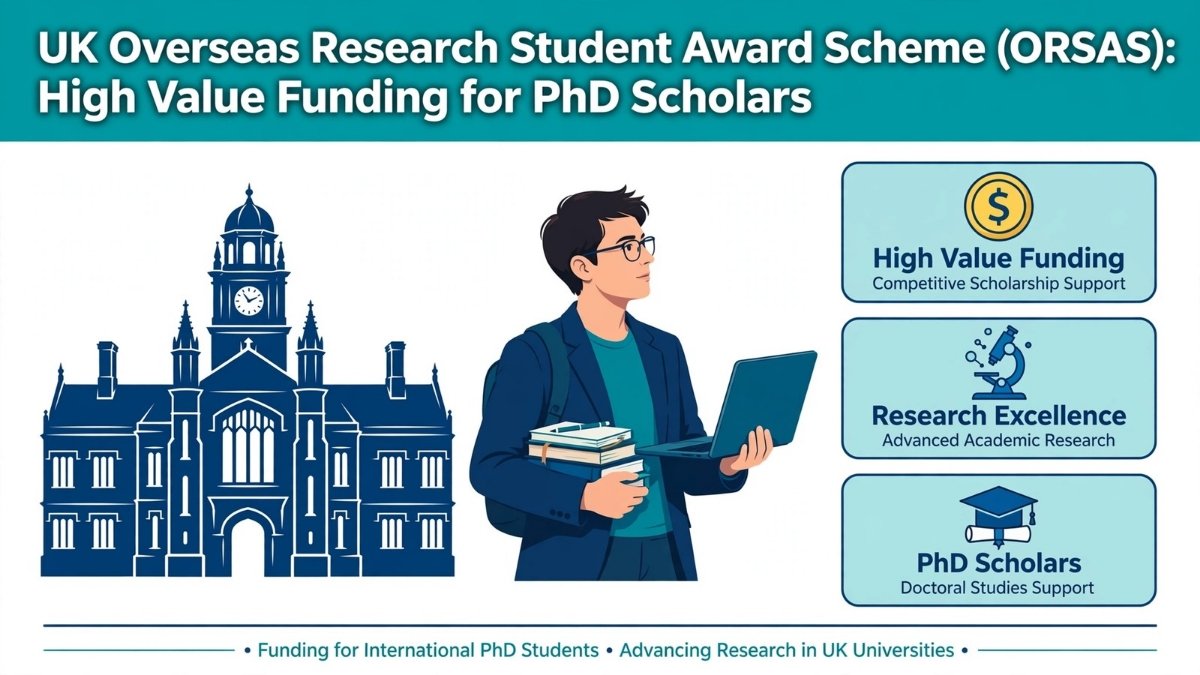
If you are planning to do your PhD in the UK and you are worried about the huge difference between home and international fees, let me tell you about a hidden gem that many PhD applicants don’t even know about: ORSAS, or the Overseas Research Student Award Scheme.
I have met so many brilliant PhD students who have a strong research proposal, but they drop the idea of studying in the UK just because an international PhD can cost £22,000 to £35,000 per year. That is just too much. But what if I tell you that with ORSAS, you can pay the same fee as a UK student?
In this guide on HireUK, I will explain to you in simple, friendly language what ORSAS actually is, how much money you get, who can apply, and how you can win it.
What is ORSAS Actually?
ORSAS stands for Overseas Research Student Award Scheme. It was originally a very famous UK Government scheme that started in 1980 to attract the best international research students to the UK.
The original national ORS scheme was closed by the government many years ago, but here is the good news: almost all top UK universities have kept this scheme alive with their own funding under different names. Today, it is known as:
- Overseas Research Scholarship (ORS)
- ORSAS / International Research Scholarship
- Vice-Chancellor’s International Scholarship
- Fee Difference Scholarship / President’s Doctoral Award
The concept remains identical and powerful. If you are an outstanding international PhD student, the university will waive the difference between the international fee and the home fee—so you only pay the home fee!https://hireuk.site/chevening-scholarship-uk-application-guide/
Real Example of Savings
Suppose at the University of Leeds, the home PhD fee is £5,000 per year and the international fee is £28,000 per year. The difference is £23,000. If you get ORSAS, the university will cover that £23,000 for you. You will only pay £5,000 per year, just like a UK home student. That is a massive saving of nearly £70,000 over three years.
How Much Funding Do You Get?
Let me be very clear: ORSAS is not automatically a full stipend scholarship on its own like Commonwealth or Chevening, but it is high-value fee relief that makes your doctorate affordable.
1. Full Fee Difference Coverage
This is the core benefit. You get full coverage for the gap between overseas and home tuition fees (typically £15,000 to £25,000+ per year depending on the university and field). Lab-based disciplines like Engineering, Medicine, and Biotechnology have higher fee gaps, so you save even more.
2. Three to Four Years of Coverage
ORSAS is awarded for the full standard duration of your research degree—usually 3 to 3.5 years for full-time research, or up to 6 years for part-time PhD scholars.
3. Stackable With Other Funding
This is the best part. Because ORSAS covers the fee difference, you can combine it with other funding streams to cover the remaining home fee and your living expenses. Many students pair ORSAS with:
- University or departmental teaching assistantships (GTA)
- External PhD grants or home country government sponsorships
- Commonwealth PhD or UKRI co-funded schemes
Many top institutions (like Oxford, Cambridge, Edinburgh, Manchester, and Leeds) will automatically pair your ORS award with a living stipend if you score top marks in the scholarship review.
Who is Eligible for ORSAS?
The eligibility criteria are straightforward and open worldwide.
1. International Fee Status
You must be classified as an overseas student for tuition fee purposes. Applicants from any non-UK country (India, Pakistan, Nigeria, Bangladesh, Ghana, Kenya, China, USA, Egypt, Turkey, etc.) are eligible.
2. Academic & Research Background
You need an exceptional academic background. Typically, universities look for:
- A First Class or Upper Second Class (2:1) Bachelor’s degree
- A Master’s degree completed with Distinction or Merit
- A high-quality, feasible Research Proposal that aligns with departmental priorities.
3. English Language Proficiency
You must satisfy the doctoral entry requirements of your target university. Most PhD programs require an overall IELTS score of 6.5 to 7.5 (or PTE/TOEFL equivalents), depending on whether the research is STEM or Humanities-based.
4. Admission Requirement
You must apply for a full-time or part-time PhD program at a participating UK university. Admission and supervisor approval are essential prerequisites before receiving ORSAS funding.
Which Universities Offer ORSAS?
Almost all Russell Group and major research-intensive UK universities offer this scheme under internal titles:
- University of Edinburgh: Edinburgh Global Research Scholarship
- University of Leeds: Leeds Doctoral Scholarships / ORS
- University of Nottingham: Vice-Chancellor’s Scholarship for Research Excellence
- University of York: Overseas Research Scholarship (ORS)
- University of Manchester: President’s Doctoral Scholar (PDS) Award
Tip: When browsing university portals, search for “International Research Scholarship”, “Doctoral Fee Waiver”, or “Global Research Scholarship”.
How to Apply for ORSAS: Step-by-Step Process
The application route for PhD scholarships differs from Master’s degrees because securing a prospective supervisor is the most crucial step.
Step 1: Secure a PhD Supervisor
Do not submit a blind application. Browse the university directory, locate academics whose research aligns with your proposal, and email them a polite inquiry. Include:
- Your CV & academic transcripts
- A concise 500-word overview of your proposed project
If a professor agrees to supervise and endorse your candidacy, your probability of securing an ORS award increases drastically.
Step 2: Draft a Strong Research Proposal
Prepare a detailed research proposal (1,500 to 2,000 words) featuring:
- Clear research objectives & background literature
- Methodology, timeline, and expected academic/societal impact
Take time to refine this document, as the scholarship committee evaluates research potential above all else.
Step 3: Submit University PhD Admission
Apply for PhD admission through the university portal once a supervisor supports your application. Upload your transcripts, certificates, proposal, IELTS results, personal statement, and two academic references. Apply early (ideally between October and January).
Step 4: Submit the ORSAS Application
In many universities, ticking the funding box on your PhD application automatically considers you for ORS/Fee Difference awards. At others (like Edinburgh or Nottingham), a separate short scholarship form is required detailing your research merit and ambassadorial potential.
Step 5: Await Selection Results
Scholarship committees evaluate applications between Spring and early Summer (April to June). If awarded, your fee status is updated to home rate, and your official offer letter reflects the fee adjustment.
Tips to Win ORSAS (From Experience)
- Contact supervisors early: Reach out to potential advisors by September or October for the following academic year intake.
- Align with departmental strengths: Frame your proposal to match ongoing research projects or funded research centers at your target university.
- Highlight publications & research output: Mention any peer-reviewed papers, conference presentations, or research assistant experience clearly on your CV.
- Target multiple universities: Apply to 4 or 5 institutions across different tiers to maximize your chances of securing fee support.
Final Words From HireUK
If your dream is to pursue a PhD in the UK but international tuition fees feel out of reach, ORSAS is one of the best mechanisms available. While it focuses primarily on bridging the tuition fee gap, cutting your tuition costs by 70% to 80% makes self-funding or securing a supplementary teaching assistantship far more manageable.
Start reaching out to prospective supervisors today to kickstart your UK doctoral journey.
Frequently Asked Questions (FAQs)
Q1: Is ORSAS a fully funded scholarship for PhD?
No, ORSAS on its own covers the fee difference between overseas and home tuition rates. However, many universities automatically bundle ORSAS with departmental stipends or Graduate Teaching Assistantships (GTA) for top-ranked applicants, making it fully funded.
Q2: Can students from any country apply for ORSAS?
Yes. ORSAS awards are open to all international applicants who pay overseas tuition rates, regardless of nationality.
Q3: Do I need a supervisor before applying for ORSAS?
While a few portals allow you to submit without a named supervisor, having an academic supervisor endorse your application beforehand is essential for a competitive submission.
Q4: What is the IELTS requirement for ORSAS PhD scholarship?
ORSAS uses the entry requirement set by your academic department. Generally, this ranges from IELTS 6.5 to 7.5 overall.
Q5: What is the deadline for ORSAS scholarships in the UK?
Deadlines vary by university, but most international doctoral research scholarship deadlines fall between January and March for entry in October.
2 thoughts on “UK Overseas Research Student Award Scheme (ORSAS): High Value Funding for PhD Scholars”