
If you are dreaming of doing your Master’s or PhD in the UK for free and you come from a developing country, let me tell you about one scholarship that is even more generous than Chevening and GREAT: the Commonwealth Scholarship.
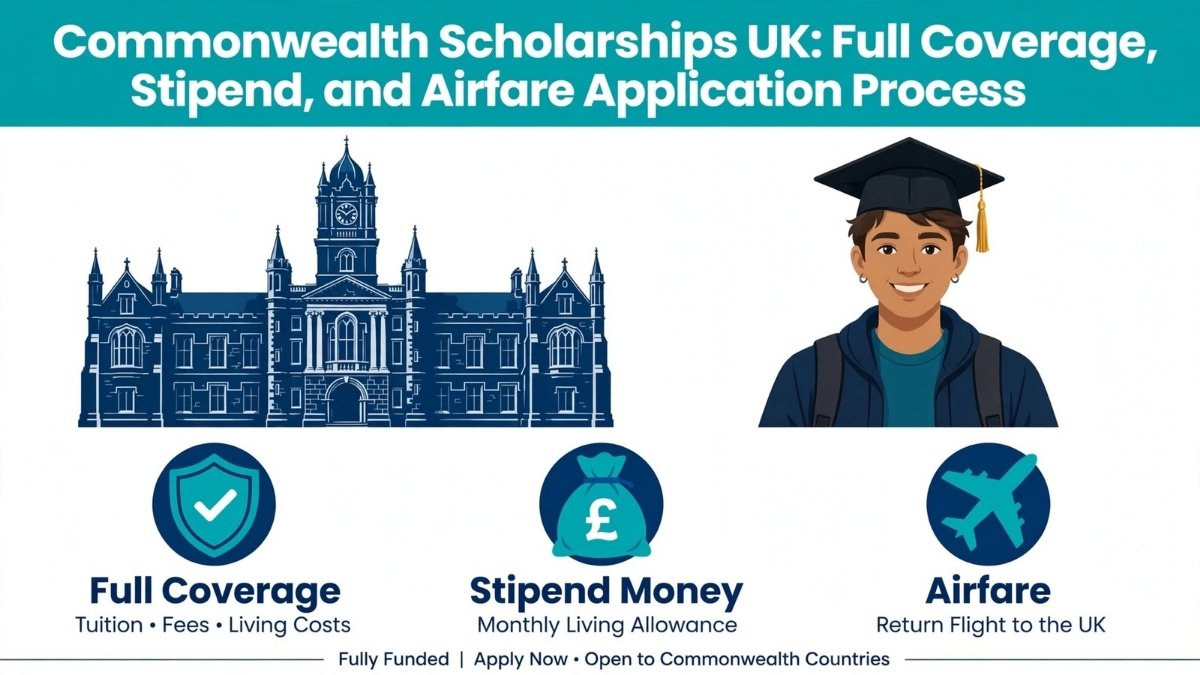
I have talked to many students who think a fully funded scholarship that covers everything, including flights, is impossible to get. But Commonwealth Scholarship is exactly that. It covers your full tuition, gives you a monthly stipend to live comfortably, pays for your flights, and even gives you extra allowances that no other scholarship gives.
In this guide on HireUK, I will explain everything to you like a friend would—what Commonwealth Scholarship actually is, who can get it, how much money you get, and how to apply step by step.
What is the Commonwealth Scholarship?
Commonwealth Scholarship is one of the most prestigious fully funded scholarship programs funded by the UK Government, specifically by the Foreign, Commonwealth & Development Office (FCDO). Its main aim is to support talented students from Commonwealth countries who cannot afford to study in the UK but have the potential to make a real difference in their home countries.
It was started way back in 1959 and till now more than 30,000 students have studied in the UK through this program. Every year, around 700 to 800 students are selected for Master’s and PhD programs.
And unlike GREAT which gives you only £10,000, Commonwealth is 100% fully funded. You don’t have to pay a single penny from your pocket.https://hireuk.site/great-scholarships-uk-guide/
How Much Money Do You Get? Full Benefits Explained
This is where Commonwealth Scholarship becomes really special. Let me break down the benefits honestly, because this is what every student wants to know:
1. Full Tuition Fee Coverage
Whatever your tuition fee is, whether it is £18,000 or £38,000, the Commonwealth Scholarship Commission (CSC) will pay it directly to your UK university. You don’t have to worry about it.
2. Monthly Stipend for Living
You will get a monthly living allowance. The rate starts at approximately £1,378 to £1,712 per month. If you are studying in London, you get even more (around £1,690 to £2,000 per month) because London is expensive. This is more than enough for rent, food, transport, and other daily expenses.
3. Return Airfare
They give you return flight tickets from your home country to the UK. At the start of your course and at the end of your course, your flights are fully paid.
4. Other Extra Allowances
This is something I really love about Commonwealth:
- Thesis grant: Helps cover the cost of preparing your thesis or dissertation.
- Study travel grant: Helps with academic travel inside the UK or abroad related to your course.
- Warm clothing allowance: Provided when you first arrive to help you adjust to the UK winter climate.
- Child allowance: If you are a single parent, widowed, or divorced with accompanying children, they provide additional financial support.
In short, it is a complete package. You just focus on your studies.
Who is Eligible for Commonwealth Scholarships?
The eligibility is simple, but you need to be careful about which category you fall into.
1. Nationality Requirement
You must be a citizen or permanent resident of an eligible Commonwealth country. There are 56 Commonwealth countries in the world, including India, Bangladesh, Pakistan, Nigeria, Ghana, Kenya, Malaysia, Tanzania, Uganda, Cameroon, South Africa, Sri Lanka, Jamaica, and many small island nations.
You must also be unable to afford to study in the UK without this scholarship. This is an important point: this scholarship is for students who really need financial help.
2. Academic Requirement
- For Master’s Scholarship: You need an upper second-class degree (2:1) or at least a lower second-class degree (2:2) with a relevant postgraduate qualification.
- For PhD Scholarship: You need a relevant Master’s degree, and your PhD research must demonstrate a clear development impact.
3. Age and Work Experience
There is no strict upper age limit, but they do prefer young and mid-career professionals. You need to show how your studies will help develop your home country.
If you are applying for Commonwealth Shared Scholarship, you need less than one year of study/work experience in a developed country.
4. Residence Condition
You must be living in your home country when you apply. If you are already living or studying in the UK, or you are a British citizen, you cannot apply.
Types of Commonwealth Scholarships
Many students get confused because there are different types. Let me make it simple for you:
Commonwealth Master’s Scholarships
This is for one-year full-time taught Master’s courses. This is the most popular route for students from low and middle-income Commonwealth countries.
Commonwealth Shared Scholarships
This is also for Master’s, but it is jointly funded by UK universities and the CSC. These scholarships are available for specific approved courses at participating universities.
Commonwealth PhD Scholarships
This is for PhD students from eligible Commonwealth countries. It covers full-time doctoral study for up to 3 to 4 years.
How to Apply for Commonwealth Scholarship: Step-by-Step Process
This process is different from Chevening and GREAT. You cannot apply directly on the CSC website alone—you must apply through a nominating agency.
Step 1: Find Your Course and University
First, find an eligible Master’s or PhD course in the UK. The course must be relevant to development (e.g., Public Health, Education, Science, Engineering, Agriculture, Environment, Economics, Governance). Check the CSC website course finder or participating university portals.
Step 2: Apply Through Your National Nominating Agency
Each Commonwealth country has a national nominating agency (e.g., HEC in Pakistan, Ministry of Education in India, Federal Scholarship Board in Nigeria). You must apply to them first. They screen applications and nominate shortlisted candidates to the CSC. Without a nomination, you cannot secure the award.
Step 3: Apply on the CSC Online Portal
At the same time, create an account on the official Commonwealth Scholarship portal (cscuk.fcdo.gov.uk). Fill in your personal details, academic history, employment background, and development impact statements.
Step 4: Write Your Development Impact Statements
This is the heart of your application. They focus heavily on development impact. You need to address:
- Development Theme: Connect your course to one of the six CSC themes (e.g., Science and Technology for Development, Strengthening Health Systems, Promoting Global Prosperity, etc.).
- Impact Statement: Explain specifically how your studies will address real issues in your home country after you return.
- Career Plans: Detail your 5-year and long-term goals after completing the scholarship.
Step 5: Submit References and Documents
Upload scanned copies of your passport/ID, academic transcripts, degree certificates, and two professional/academic reference letters before the official portal deadline.
Step 6: Interview and Final Results
If your national agency nominates you and the CSC approves your application, you may be interviewed. Final selection outcomes are typically published between June and August for intake in September/October.
Tips to Win a Commonwealth Scholarship
Here are essential tips to make your application stand out:
- Choose a development-linked course: Pick programs with direct practical relevance to your country’s local challenges (e.g., MSc Public Health, MSc Environmental Management, Water & Sanitation Engineering).
- Quantify your impact statement: Avoid generic statements like “I want to help my country”. Instead, state concrete actions: “I will implement a community health framework to train 100 rural healthcare workers”.
- Apply to both Master’s and Shared schemes: Check if you qualify for both Commonwealth Master’s and Commonwealth Shared Scholarships to maximize your chances.
- Prepare months in advance: Give your referees sufficient time to write detailed letters, and refine your development impact essays carefully.
Final Words From HireUK
If you are from a Commonwealth country and cannot afford to study in the UK, the Commonwealth Scholarship should be your top priority. It is more comprehensive than GREAT and covers every major expense, including flights and living costs.
Start researching your eligibility and courses early to build a compelling development story.
Frequently Asked Questions (FAQs)
Q1: Is Commonwealth Scholarship fully funded like Chevening?
Yes, and in some ways it covers even more. Commonwealth covers full tuition, monthly stipends (£1,378–£2,000 depending on location), return flights, thesis grants, study travel allowances, and warm clothing allowances.
Q2: What is the difference between Commonwealth Master’s and Commonwealth Shared Scholarship?
Commonwealth Master’s Scholarships are funded directly via the UK Government through national nominating bodies. Commonwealth Shared Scholarships are jointly funded with participating UK universities for specific approved courses.
Q3: Do I need IELTS for Commonwealth Scholarship?
The CSC portal itself may not strictly require IELTS at the initial form stage, but your chosen UK university will require proof of English proficiency (like IELTS, TOEFL, or PTE) to grant you an unconditional admission offer.
Q4: Can I stay and work in the UK after Commonwealth Scholarship?
No. You are required to return to your home country upon completing your studies to contribute to its national development.
Q5: Can students from any country apply or only Commonwealth countries?
This scheme is strictly for citizens and permanent residents of eligible Commonwealth member nations. If your country is not part of the Commonwealth, you can explore Chevening or GREAT Scholarships.
1 thought on “Commonwealth Scholarships UK: Full Coverage, Stipend, and Airfare Application Process”